If you've been following along, Karen Bolan and I have been exploring different aspects of collaboration together, then reflecting on our conversations on our blogs. You can find the first two entries in our series here on my blog and on Karen's blog as well.
Wednesday, January 5, 2022
Exploring Collaboration: Myths
Wednesday, December 15, 2021
Exploring Collaboration - tips and tricks for forming a bee or swap group
Here we are, round 2 of Exploring Collaboration! Last time, Karen and I discussed different kinds of collaborations that we enjoy. Today, let's chat about how to form a collaborative team to make those projects happen!
Bees
Some tips and tricks for forming a bee group:
1) Establish your goals. What are you hoping to accomplish through your bee? Do you want to make traditional blocks and hone your piecing skills? Do you want to experiment with improv? Make charity quilts? Write it all down so you can share these goals with potential bee members.
2) Set rules. I know, I know, quilting is supposed to be fun and rules are for the birds. Trust me, once your bee gets rolling you'll be glad to have some rules in place. When will prompts come out? How will they be communicated (email? Instagram DM? Facebook? In person?), when are blocks due? What happens if you can't complete your blocks on time? Having rules in place will help you avoid drama later on.
3) Decide who to invite. Will your bee be made up of friends from your local guild? Instagram friends? Random strangers? Honestly, I recommend inviting people you know at least a little bit. Think about people who fit in with your goals, and who will be reliable.
4) Consider diversity when you ask people to join you. Quilters of different ages, ethnicity, sexuality, etc can all learn from each other and frankly, make more interesting quilts!
5) Make sure potential members are aware of the group goals and rules before they commit. Give them the opportunity to gracefully say no if joining your bee is not for them.
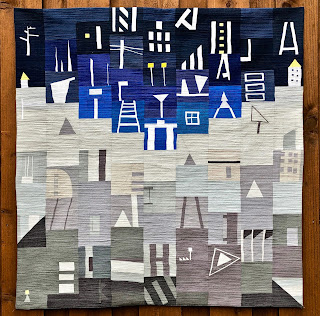
| Urban Emergence, my 2020 bee quilt made by the Solid Seven Bee. first place group quilt at Quiltcon Together in 2021, will hang at quilt con in Phoenix in February, 2022 |
Block Swaps
Tips and tricks for forming a block swap group:
1) Decide who to invite. Again, will it be a local only swap, where blocks can be swapped at a guild meeting or delivered in person? Or an internet swap where blocks will be mailed? Are members willing to mail blocks internationally or should the swap be restricted to members in one country?
2) Make sure swappers know the rules of the swap. What is the block to be made? Does everyone have access to the free pattern if blocks will all be the same? What fabric should be used? What size should the blocks be?
3) Set a total for blocks to be made. This can be flexible! Many swaps that I have participated in have a maximum number of blocks. Often, however many blocks you send is how many you receive in return. Send 10 blocks/receive 10 back.
4) Set a deadline for the swap leader to receive all of the blocks. If a swapper doesn't send their blocks in time, they are not included in the swap.
5) Cover your postage! As a swap leader, you should not be responsible for shipping everyone's blocks back to them. Some ways to do this: charge a flat fee to enter the swap paid through PayPal or another online method, have each swapper include a postage paid, self addressed envelope with their blocks, or arrange for in person delivery and pick up.
Bees and swaps are meant to be fun! By carefully planning, setting goals and establishing rules, these groups can be drama free and create lasting friendships among quilters.
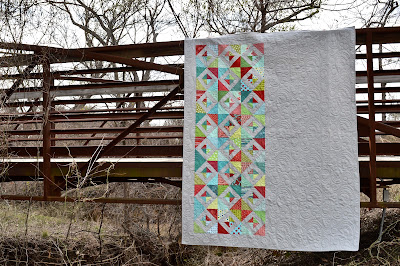
| my Dresden block swap quilt made in 2017 with blocks from members of McKinney Modern Quilt Guild |
Wednesday, December 1, 2021
Exploring Collaboration - Bees and Block Swaps
I've really been enjoying exploring different aspects of collaboration with fellow modern quilter, Karen Bolan. You might remember reading about Welcoming Lamp, the project we collaborated on several months ago. Our conversations have continued since then and we are working on a series of blogposts to open up conversation in the quilting community about collaborating.Karen and I will offer articles on this topic twice a month and encourage you to join in by sharing your thoughts in the comments.
For our first posts, we are sharing our thoughts about the different types of collaboration. You can read my thoughts on quilting bees and block swaps here, then hop on over to Karen's blog to read more.
Bees
Maybe some of you have participated in quilt bees. This is one of my favorite ways to collaborate. Basically, a group of quilters commits to working together for an extended period of time. Each month, one member of the group is the queen and gives the other members a prompt, block pattern, color palette or other specifications about what they desire for finished blocks. Bee members have that month to complete the requested blocks for the queen. Then the next person becomes queen and the cycle begins again.
Bees can be traditional, based on block patterns that everyone has access to (either original designs by the queen, free tutorials available online or a pattern all members have purchased), or less traditional, based on thematic prompts or improv methods of quilting. I've participated in both types and enjoy them for different reasons. Also, bees can be made up of all local quilting buddies or quilters who live at a distance, requiring blocks to be mailed.
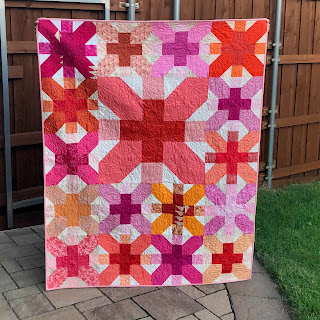
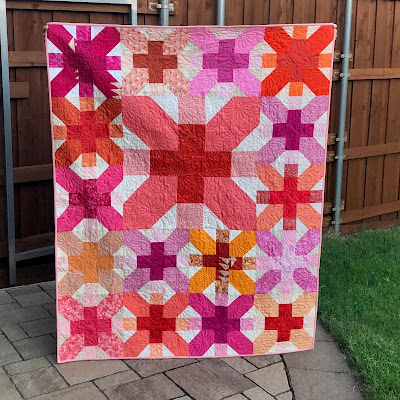
My most recent traditional bee quilt was made in pinks and oranges using the japanese x and + block.
| made by members of the McKinney Modern Quilt Guild |
Just for fun, I enlarged the block to add one giant block to my quilt. It was fun to see the fabrics each bee member used in their blocks and how they all played together in the end.
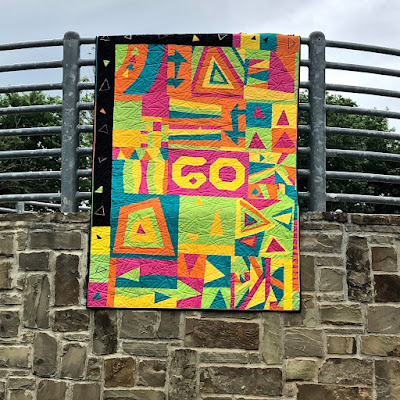
Recently I've been enjoying improv bees. First I was a member of the Solid Seven Bee and more recently, the newly formed Quilts Unscripted Bee. I haven't had a turn to be queen in the Quilts Unscripted Bee yet (soon!) but I have several quilts completed by the Solid Seven. One of my favorites is my This is 60 quilt with blocks they made to help me celebrate my 60th birthday. I gave the bee members a bright, happy color palette and asked that they include at least one triangle in each block.
| made by members of the Solid Seven Bee |
When the blocks arrived they were all different sizes. Puzzling together improv blocks is my favorite part of the process!
Block Swaps
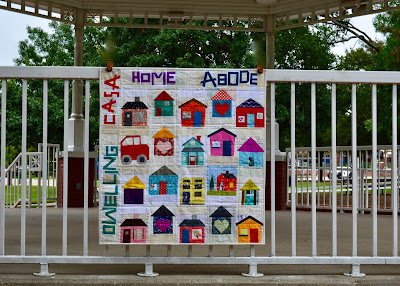
Another kind of collaboration I love is block swaps. Again, block swaps can be held among local quilty friends or with quilters all around the world. During the Covid lockdown, I organized a house block swap among my local quilty pals.
| of course I added my little red car to the mix! |
Each quilter dropped their finished blocks off at my house. When I had received everyone's blocks, I mixed them all up and gave each quilter back as many blocks as they had given me. There were so many wonderful takes on the house block... from patterned houses to totally improv ones.
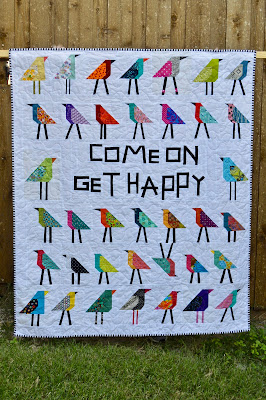
A couple of years ago, I organized an internet block swap of bird blocks based on the free tutorial here. Quilters mailed me their blocks (you should have seen the hundreds of bird blocks that flew into my house!). Again, I scrambled the blocks and mailed new ones back to each participant. My finished quilt is one of my favorite quilts ever.
Have you ever participated in a bee or block swap? In an upcoming post I'll share some tips and tricks for organizing and participating in your own collabs.